
Data Center Computing Efficiency
Environmental Issue
The ever-present digitalisation trend, together with the recent Gen AI boom, is rapidly pushing the semiconductor industry towards producing increasingly powerful hardware. This surge incomputational capabilities is having a significant impact on data centres, pushing their energy demands to new heights. By 2030, data centres are expected to consume up to 8% of the world’s electricity, a sharp rise from the current 2%. To put this into perspective, data centres in 2030 may require more electricity than the expected global electric car fleet.
A critical metric for measuring sustainability in data centres is Power Usage Effectiveness (PUE). This indicator assesses the efficiency of a facility’s electricity use, particularly how it powers servers in comparison to other functions like cooling or lighting. Our February 2023 Theme of the Month highlighted the urgent need for sustainable data centre infrastructure, emphasising the increasing importance of Liquid Cooling and Heat Recovery solutions to optimise PUE and effectively utilise the heat generated. However, as data centres approach the theoretical limit of PUE, enhancing infrastructure for further improvements becomes more challenging.
“Enhancing data center sustainability involves more than solely reducing PUE”
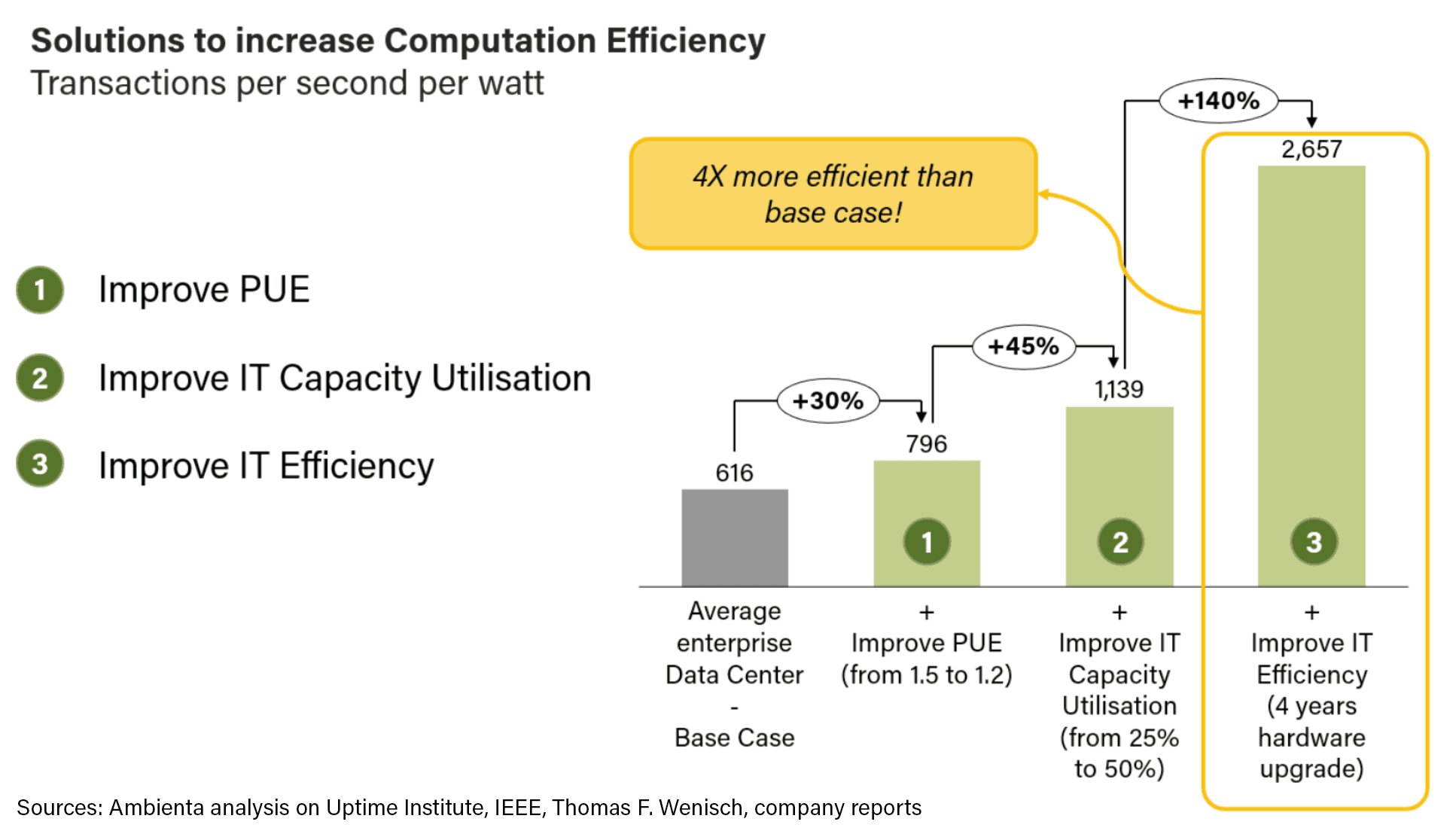
An often-underestimated factor in this scenario is the Computation Efficiency. This metric evaluates the amount of work servers can perform per unit of electricity consumed. Enhancing Computation Efficiency could be a game-changer in boosting a data centre’s sustainability performance, potentially having a much greater impact compared to infrastructure modifications alone.
Computing Efficiency involves two main parts:
- IT Capacity Utilisation: refers to how much work the server is actually doing compared to what it could potentially do. Servers usually run at lower capacities (around 20%) to limit the risks of unavailability, but increasing utilisation is key to achieving higher computing efficiency.
- IT Efficiency: refers to how effectively IT equipment, especially processors like CPUs and GPUs, can perform tasks for each watt of power used. This efficiency mainly depends on the type of processors and the hardware provider.
Today, data centre operators are often hesitant to share details about Computing Efficiency as it’s seen as a proprietary business metric. Yet, there is growing interest from customers and regulators, supported by academics and industry experts who highlight the importance of these metrics in understanding the sustainability of data centres.
Solutions
With the recognition of the importance of IT Capacity Utilisation and IT Efficiency shifting into focus, certain software and hardware solutions are beginning to and will continue gaining increasing attention. These are not just vital for sustainability; they also serve as operational tools to cut down on running costs in data centres.
Software plays a crucial role in enhancing IT Capacity Utilisation. Tools such as workload placement and virtualisation software effectively optimises workloads across various machines and adapts to changing workload demands.
In terms of IT Efficiency, the selection and updating of components is critical. The primary focus should be on CPUs, GPUs, and storage, as these are major power consumers in IT equipment. Efficient hardware is emerging, offering more computational power for the same energy consumption. Regular hardware upgrades, ideally every 4-6 years, can significantly improve the efficiency of data centres. It has been calculated that replacing server hardware that is four years old with new models can lead to an average performance improvement of 140%.
“Refreshing IT hardware is the most effective way to increase Computation Efficiency.”
Investment Ideas
Investment strategies should target areas where economic growth and environmental benefits intersect. Companies at the forefront of virtualisation and workload management include VMware (part of Broadcom) and Red Hat (under IBM).
For efficient IT hardware, firms like AMD, Nvidia, ARM, and BE Semiconductor Industries are making significant steps in enhancing the efficiency of the IT equipment.
“Investment strategies should target areas where economic growth and environmental benefits intersect.”