


MedTech: Caring for the planet while caring for the patient
Environmental problem
Healthcare accounts for around 4–5% of global greenhouse gas emissions, more than aviation, yet it rarely features in the sustainability debate.[1]
Healthcare is seldom the first sector that comes to mind when we think about environmental impact. Its footprint is harder to see than that of power generation or transport, as it is largely embedded in the products and processes of care: the sterile drape, the single-use catheter, the MRI scanner running around the clock, the anaesthetic gas vented after surgery. Patient safety rightly comes first, so sustainability has historically been a secondary design criterion, even if this does not make the footprint small.
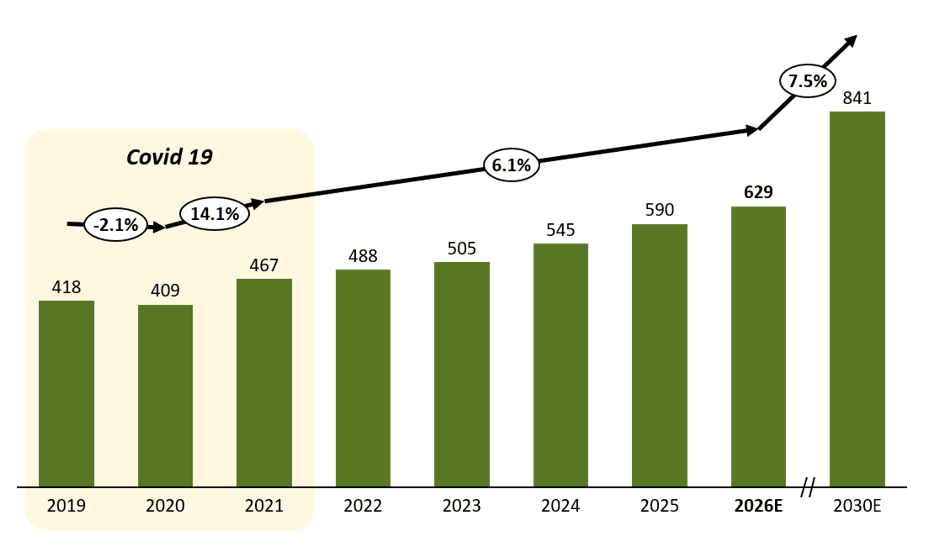
That footprint grows with two forces: i) The volume of care is rising structurally, driven by ageing populations and the increase in chronic conditions such as diabetes and cardiovascular disease:[2] the global MedTech market is worth around $629bn in 2026 and is expected to reach $841bn by 2030, a 7.5% CAGR.[3] ii) Intensity: each act of care is resource-intensive: a single high-intensity surgical procedure can generate up to c.800 kg of CO₂-equivalent, comparable to c.4,000 km of emissions of a typical diesel powered Euro 6 vehicle.[4]
Figure 1. Global MedTech Market, 2019-2030, USD Bn (Source: Frost and Sullivan)
To see where this footprint originates, and who can reduce it, we follow a medical product along its value chain, the lens we use throughout this piece. Contract development and manufacturing organisations (CDMOs) make products on behalf of brand owners; original equipment manufacturers (OEMs) design and commercialise consumables, diagnostics and capital equipment; distributors and service providers bring products to market, maintain and sometimes reprocess them; collective buyers such as NHS Supply Chain, UGAP, or CONSIP set purchasing frameworks; and hospitals, clinics and laboratories use the technology to deliver care.
Figure 2. The MedTech value chain (Source: Expert calls, Press search, Ambienta analysis)

Along this chain, environmental pressures fall into four categories: what products are made of, what they consume, what they release and what they leave behind.
- Material intensity. Sterility requirements have made single-use the default. Material choice, product geometry and packaging specifications are decided by OEMs and their CDMOs, typically resulting in virgin fossil-based plastics and multilayer sterile packaging. Inventory frictions between distributors and hospitals can result in excess stock, inefficient replenishment and the expiry of sterile products before use, adding to material waste across the value chain.
- Energy intensity. Energy use (for heating, cooling and running machines) accounts for around 40% of healthcare’s emissions.[5] A single MRI scanner can draw the power of 10–25 homes,[6] and its energy profile, like that of other large hospital equipment, is set by the OEM but paid for by the provider, often around the clock for a decade or more.
- Pollutant release. Inhaled anaesthetics are barely metabolised and almost entirely released to the atmosphere: they emitted around 3 million tonnes of CO₂-equivalent in 2014, c.80% of it from desflurane, a gas around 2,500 times more potent than CO₂.[7] Whether such gases are vented or recirculated depends largely on how OEMs design anaesthesia and refrigeration systems.
- End-of-life waste. Healthcare generates around 15 million tonnes of plastic waste a year, which is largely incinerated,[8] and around 15% of overall health care waste is hazardous, primarily infectious, waste. Precautionary handling often mixes clean and contaminated streams, ruling out recycling. While this waste manifests in the hospital, its volume is largely decided by formats chosen upstream at the product design stage.
In short, healthcare’s environmental footprint is felt downstream, where care is delivered, but designed upstream, by the companies that develop and manufacture medical technology.
Environmental solutions along the value chain
Across the value chain, MedTech’s environmental solutions fall into three families: using less, using better and using again.
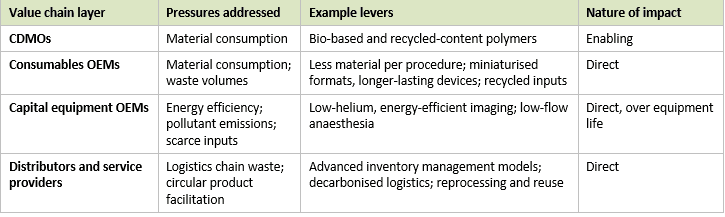
Solutions are emerging against each of the four pressures, at every layer of the chain.
- CDMOs: substituting materials at source. As the point where new materials enter medical supply chains, CDMOs can introduce bio-based polymers that cut carbon footprint by up to 80% versus conventional plastics while meeting regulatory requirements. Several European CDMOs currently produce medical-grade plastic consumables from bio-attributed polymers. The materials used are chemically identical to the fossil grade, so OEMs need no new approval. Their role is enabling: impact depends on OEMs specifying these materials, and adoption is still nascent.
- Consumables OEMs: less material, longer life, recycled inputs. Consumables OEMs decide how much single-use material goes into each procedure. They can use less material, for example through pre-filled formats. Pre-filled flush and lock syringes remove the ampoules, drawing-up needles, and alcohol wipes needed for manual preparation. In anaesthesia, switching to pre-filled emergency drugs cut syringe use by 84%.[9]
- Capital equipment OEMs: locking in a decade (or more) of efficiency. Here, benefits accrue over the equipment’s life. Dedicated, permanent magnet MRI scanners for limbs and joints can run on about 1 kW from a standard socket and require no cryogenic gases. Conventional outpatient scanners, by contrast, use 82.7–171.1 MWh a year[10] and rely on scarce cryogenic gases such as helium.
- Distributors and service providers: inventory, logistics and reuse. While distributors cannot redesign products, better stock rotation and improved inventory management models can reduce expired inventory and decarbonised logistics can cut transport emissions. Service providers can go further yet, with sterilisation and textile reprocessing services making reusable instruments and surgical textiles a practical alternative to single-use items.
Figure 3. Sustainability solutions along the MedTech value chain
Investment opportunities
Outside the ten largest multinationals, MedTech is a fragmented market, including c. 34,000 SMEs in Europe alone.
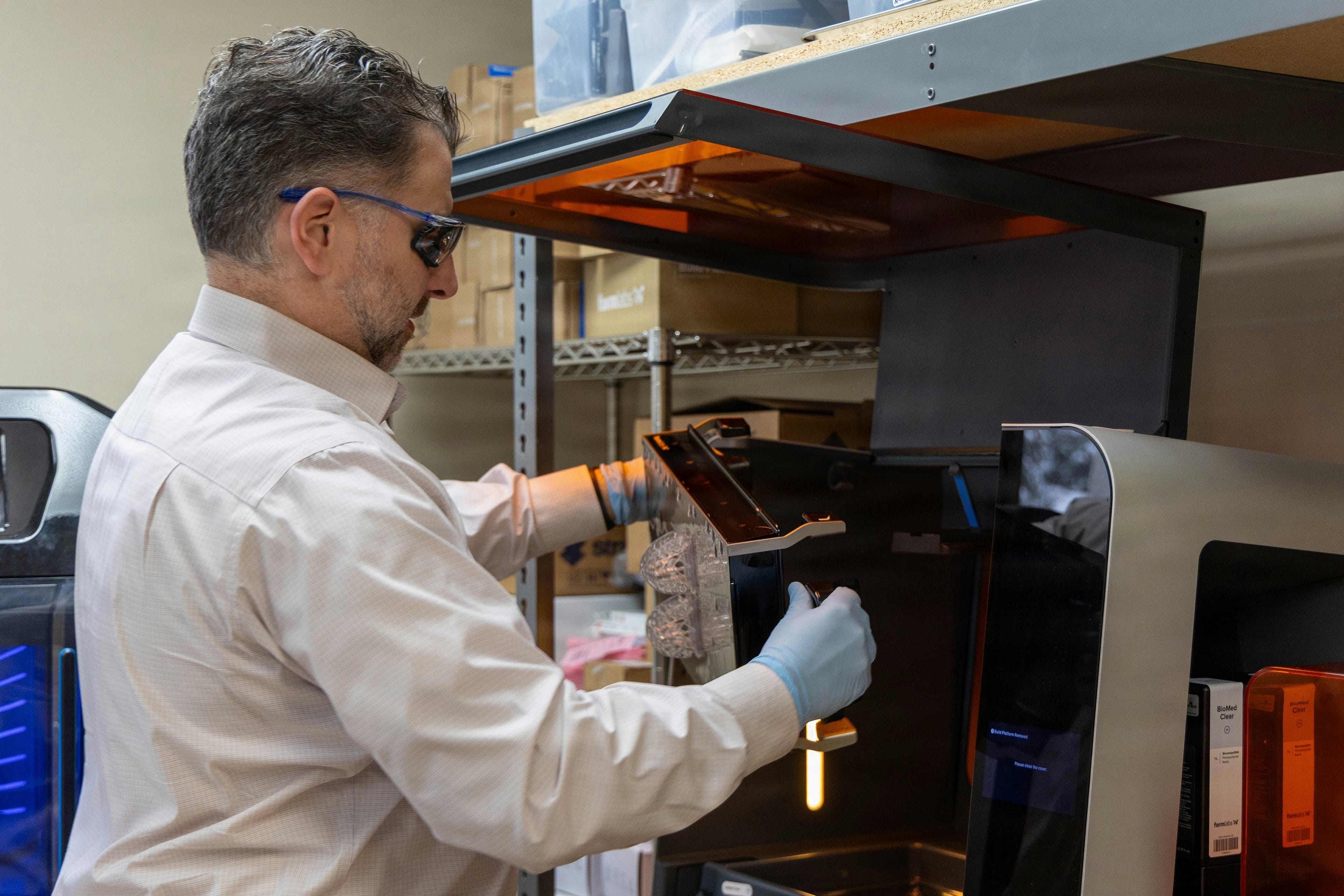
The ten largest multinationals, integrated across the whole value chain, hold around 37% of global revenues; with the remainder mostly being spread across specialists at each layer. Fragmentation is even greater locally: Italy’s €13bn market counts some 4,400 players. For an environmental investor this matters twice. It creates entry points and room for consolidation, and it makes environmental additionality easier to identify, since a superior product line is averaged out in a diversified multinational but can be the core of a specialist’s offering.
Each layer of the chain combines a distinct investment case with a distinct environmental angle:
- CDMOs operate in specialised niches protected by technical and regulatory know-how, with sticky multi-year OEM contracts; environmentally, they are the gateway for lower-impact materials into the value chain and can be most valuable where they are critical to the substitution of conventional materials.
- OEMs offer recurring revenues of different kinds: procedure-driven demand for consumables, installed-base lock-in for diagnostics, and upgrade and aftermarket cycles for capital equipment. In each case, the environmental benefit is tied to the business model - less material per procedure, less plastic per test, lower energy and helium costs over the equipment’s life - so sustainability strengthens, rather than competes with, the commercial proposition ensuring that financial and environmental performance are collinear.
- Distributors and service providers operate in fragmented, often regional markets that leaders consolidate through buy-and-build; their environmental exposure is more selective, strongest where scale funds better inventory management and logistics, or where the model is built around reprocessing and reuse.
Across all layers of the value chain, Ambienta looks for companies whose environmental performance is a reason customers buy, represents a material share of revenues, and can be measured against a credible baseline, from tonnes of virgin polymer substituted at a CDMO to litres of helium avoided per installed scanner.
Closing thoughts
The same sterility requirements, single-use formats and energy-intensive equipment that make modern healthcare safe and effective also make it a significant source of material consumption, energy use, pollutant emissions and waste.
As regulatory and societal pressures increase and resource efficiency becomes an increasingly important driver of cost savings, MedTech companies are beginning to differentiate themselves through measurable environmental improvements. While the sector’s environmental transition remains at an early stage, clear trends are emerging, creating opportunities for investors equipped to identify genuine environmental differentiation.
[1]Health Care Without Harm and Arup (2019), Health care’s climate footprint: 4.4% of global net emissions (c.2 GtCO₂e). Aviation comparison: commercial aviation accounts for c.2.5% of global CO₂ emissions (IEA; Our World in Data).
[2]WHO, Cardiovascular diseases fact sheet; Wang et al. (2025); CDC, Leading causes of death; as compiled in Ambienta MedTech sector research (June 2026).
[3]Frost & Sullivan; Statista; Ambienta analysis (MedTech sector research, June 2026).
[4]Rizan et al. (2020), “The carbon footprint of surgical operations: a systematic review”, Annals of Surgery: range of c.6–814 kgCO₂e per operation.
[5]Health Care Without Harm and Arup (2019), as summarised by WHO Foundation, “Five Fast Facts on Healthcare’s Climate Footprint”. The c.40% refers to the generation of electricity, gas, heating and cooling across health facilities and their supply chains.
[6]Ambienta MedTech sector research (June 2026), based on expert interviews and press search.
[7]Vollmer et al. (2015), “Modern inhalation anesthetics: potent greenhouse gases in the global atmosphere”, Geophysical Research Letters – 3.1 ± 0.6 MtCO₂e released in 2014, c.80% from desflurane. Desflurane GWP100: 2,540 (NHS Sustainable Development Unit).
[8]CSIRO (2024), Plastic waste in healthcare – what is happening internationally.
[9]Dr M. Clayton-Smith, Dr A. Kendall-Smith & Dr T. Clarke, “The Environmental Benefits of Using Prefilled ‘Emergency’ Drugs”, Manchester University NHS Foundation Trust.
[10]Company product specifications (company data); Woolen et al., Radiology (2023), measurements on four outpatient MRI scanners.
Important information
This material is of a promotional nature and is provided for information purposes only. Please note that this material may contain technical language. For this reason, they may not be suitable for readers without professional investment experience. This document is issued by Ambienta SGR S.p.A. It is not intended for solicitation or for an offer to buy or sell any financial instrument, distribution, publication, or use in any jurisdiction where such solicitation, offer, distribution, publication or use would be unlawful, nor is it aimed at any person or entity to whom it would be unlawful to address such a document.
This material is of a promotional nature and is provided for information purposes only. Please note that this material may contain technical language. For this reason, they may not be suitable for readers without professional investment experience. This document is issued by Ambienta SGR S.p.A. It is not intended for solicitation or for an offer to buy or sell any financial instrument, distribution, publication, or use in any jurisdiction where such solicitation, offer, distribution, publication or use would be unlawful, nor is it aimed at any person or entity to whom it would be unlawful to address such a document.
Nothing in this document constitutes legal, accounting or tax advice. The information and analysis contained herein are based on sources considered reliable. Ambienta SGR S.p.A uses its best effort to ensure the timeliness, accuracy, and comprehensiveness of the information contained in this marketing communication. Nevertheless, all information and opinions as well as calculations indicated herein may change without notice.
Ambienta SGR S.p.A. has not considered the suitability of this investment against your individual needs and risk tolerance. To ensure you understand whether our product is suitable, please read the Prospectus and relevant offering documents. Any decision to invest must be based solely on the information contained in the Prospectus and the offering documentation. We strongly recommend that you seek independent professional advice prior to investing.