


Railways
Environmental problem
Transportation accounts for approximately 9 billion tonnes of CO₂e annually
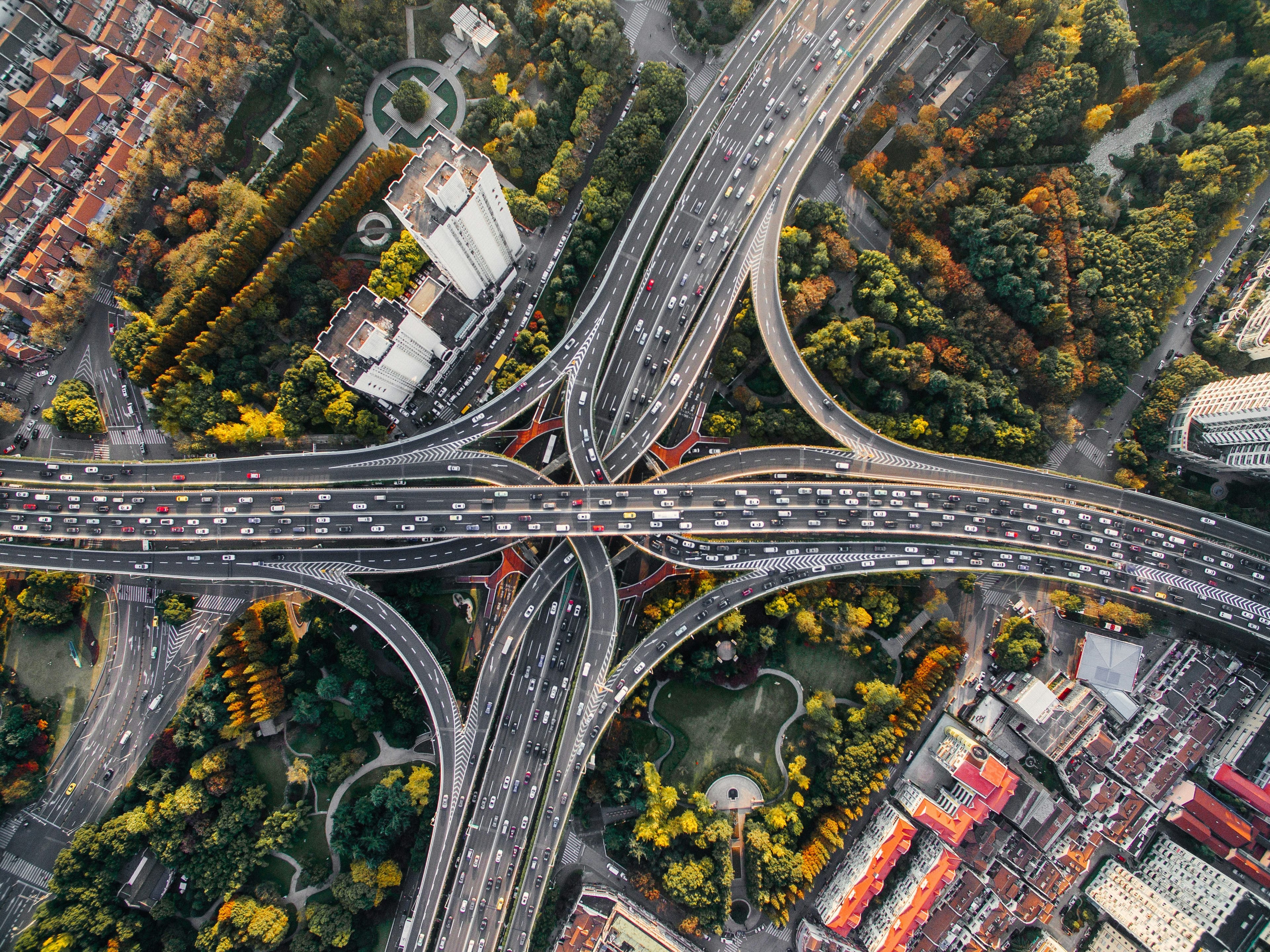
Transportation is the circulatory system of the modern economy, but it is also one of its largest environmental liabilities. Every year, the industry moves 68 trillion passenger-kilometers and 170 trillion tonne-kilometers of freight, the equivalent to every single person on earth traveling around 8’000 km every year transporting 2.5 tonness of goods.
The environmental footprint is substantial: transportation accounts for approximately 9 billion tonnes of CO₂e annually, around 15% of global greenhouse gas emissions, with energy demand and carbon output its most visible impacts.
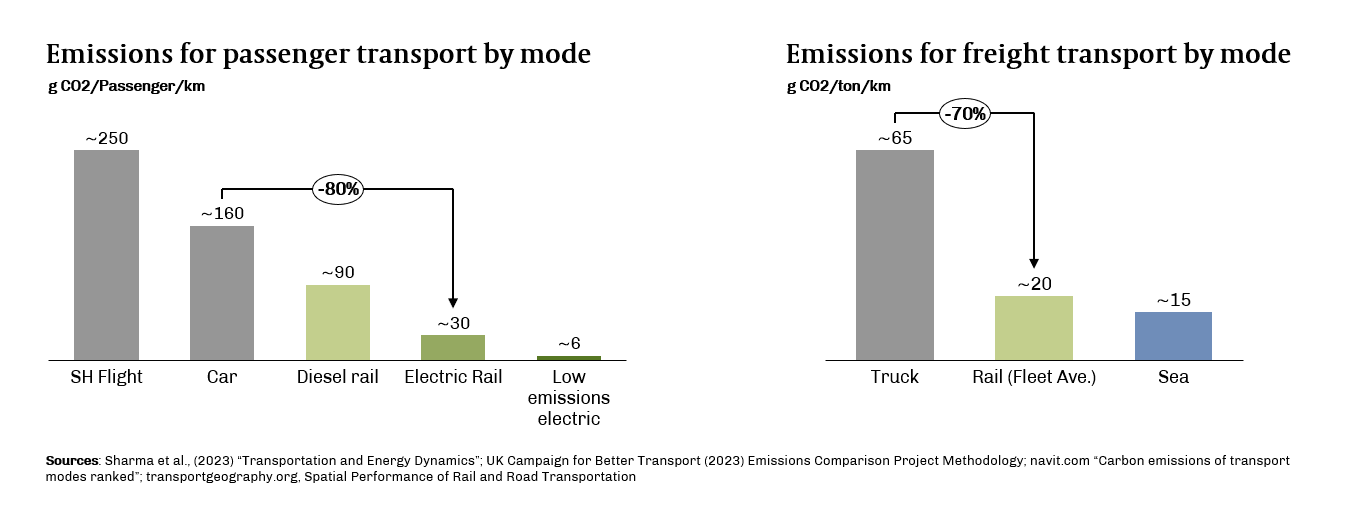
The environmental debate therefore often focuses on decarbonisation, and in particular on replacing internal combustion engine vehicles with electric alternatives. This is essential, but it is only one part of building a sustainable transportation system. Cars, even when electric, have extremely low utilisation rates and move significant vehicle mass for just one or two passengers in most cases, while contributing to local pollution through tyre wear and brake dust.Aviation has an even higher emissions intensity per passenger-kilometre and currently has no cost-competitive zero-carbon alternative: sustainable aviation fuels are still 3-5x more expensive than fossil jet fuel, while electric aircraft remain limited in range and carrying capacity.
The challenge is therefore not only to change the powertrain and eliminate fossil fuels, but also to improve the efficiency of the transportation system as a whole.
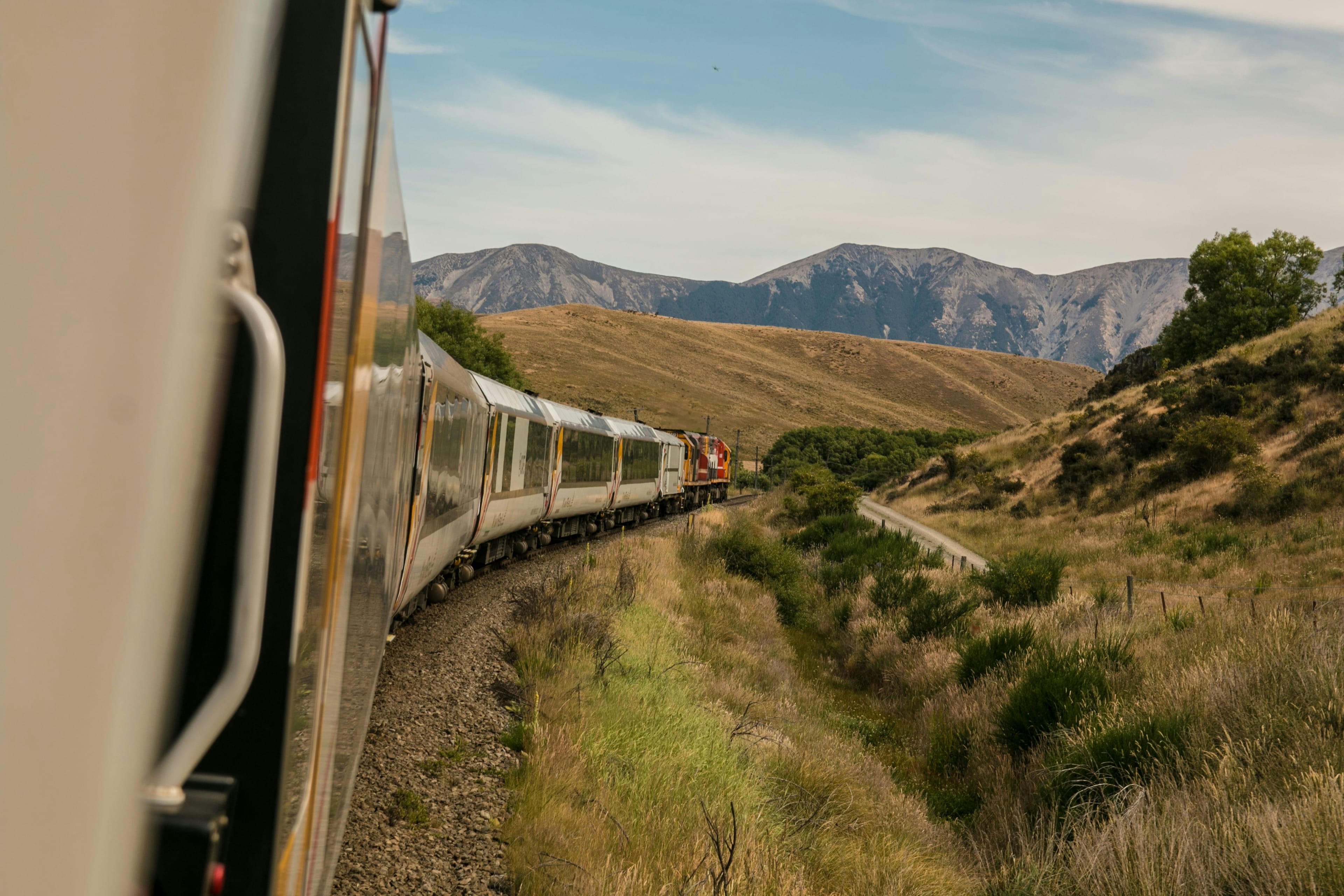
Rail is structurally advantaged, but not a universal substitute
Rail transport is structurally advantaged from an environmental perspective: steel-on-steel contact minimises rolling resistance, trains carry large volumes of passengers and freight at high utilisation rates, and the mode is extensively electrified, allowing it to benefit directly from grid decarbonisation. The result is a striking efficiency differential. Rail is one of the most sustainable modes of transport, moving around 8-10% of global passengers and freight while accounting for just 1% of transport sector emissions, with emissions per passenger-kilometre or tonne-kilometre some 70-80% lower than road equivalents.
However, railways are not a universal substitute. Their applicability is limited by the fixed nature of the network, lower route flexibility, weaker last-mile capillarity and the need for sufficient demand density to justify high infrastructure and operating costs. Reliability is also often a critical flaw: rail networks are shared, highly scheduled systems, where delays or infrastructure failures can cascade across routes, eroding passenger and shipper confidence.
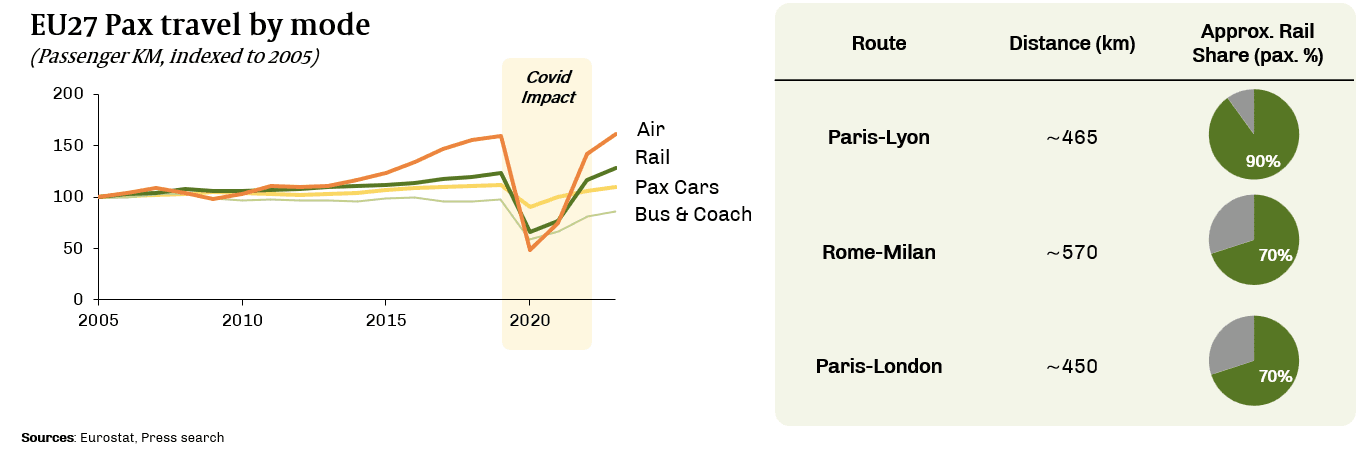
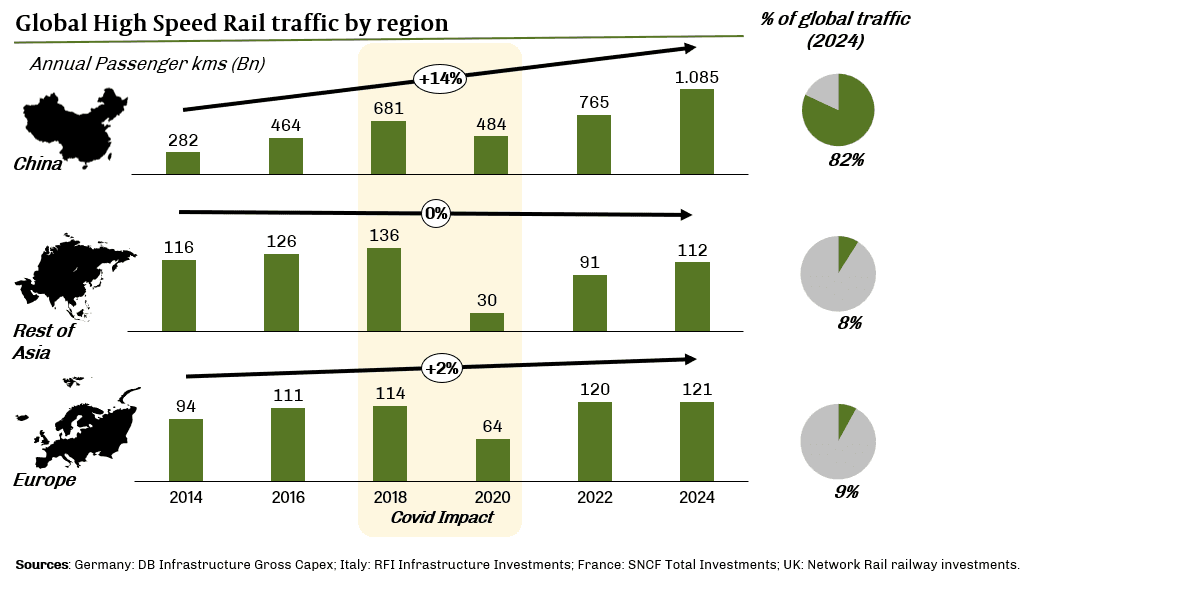
In passenger transport, modal shifts work best where density, distance and network quality align. High-speed rail is particularly effective on intercity corridors of roughly 300–800 km, where rail can compete with air on door-to-door travel time. In these corridors, when rail’s door-to-door travel time is no more than around one hour longer than flying, rail can often capture more than half of passenger demand. Routes such as Paris-Lyon, Rome-Milan and Paris-London illustrate what high-speed rail can achieve when competitive with air: market shares of 70-90% and meaningful emissions reductions at scale. In Europe, rail passenger traffic has grown faster than car travel over the past two decades, supported by the expansion of high-speed networks across the continent.
The more striking transformation, however, has occurred in China, where sustained infrastructure investment has driven a fourfold increase in high-speed passenger traffic over the past ten years.
The use of railways for freight has experienced a different dynamic to passenger rail. It remains highly competitive for heavy, regular, long-distance flows, but less suited to fragmented, time-sensitive or highly distributed logistics. Rail remains therefore more exposed to heavy industries and bulk shipments, while road freight is more flexible for lighter and more fragmented supply chains. Overall rail volumes have therefore declined both in Europe and in the US, reflecting a structural shift in the composition of goods transported toward categories where trucks hold a natural advantage.
Investment opportunities
The global rail supply market is worth approximately €220 billion annually and is expected to grow at around 3% per year.
Railway infrastructure owners and operators are often government owned and therefore not accessible as investments, with the notable exception of railway companies listed in the US. Therefore, investment opportunities are more often found upstream in the supply chain. The global rail supply market is worth approximately €220 billion annually and is expected to grow at around 3% per year. While growth is limited, much of the value is linked to maintenance, replacement and renewal of an installed base of long-lived assets, providing in many cases stable and recurring revenues.
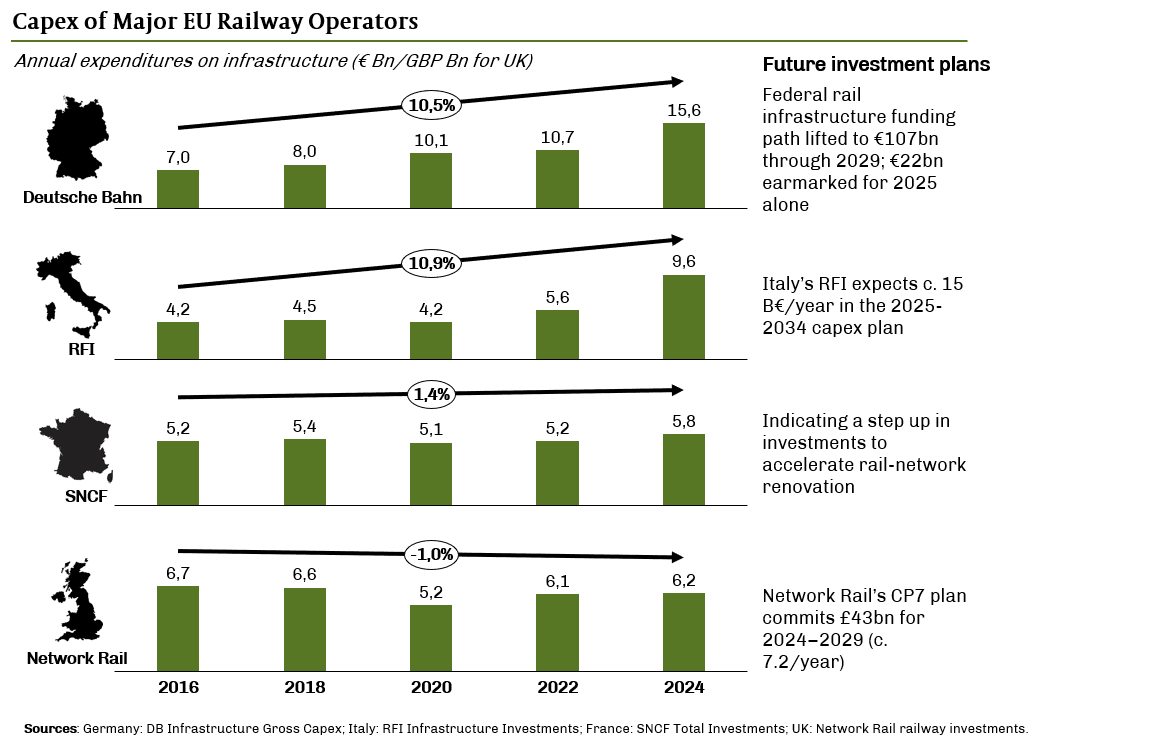
Furthermore, the headline growth rate masks more attractive pockets of expansion that can deliver above-market growth within an otherwise mature industry, such as signalling and control, automation and digitalisation and electrification. There are also significant differences at a geographical level: investments in rail infrastructure in Italy and Germany for example have been growing at double digit rates, and other major European countries such as France and the UK have signalled material increases in planned capital expenditure ahead.
Signaling and control is arguably the most attractive growth segment. Europe’s migration toward a standardised signalling architecture represents a multi-decade investment programme worth tens of billions of euros, yet penetration remains low, typically in the range of10-20%, across several major markets. The opportunity spans a broad range of products and services: trackside and onboard systems, train-position detection, communications equipment, traffic-management software, interlocking systems, safety computers and integration services. As signaling shifts from mechanical and analogue systems toward digital architectures, replacement cycles shorten and software capabilities become more important. This increases the attractiveness of specialised integrators and component suppliers able to support complex deployments in capacity-constrained markets.
Automation and digitalisation represent a further growth avenue. Rail freight and network operations remain less automated than other transport segments. Digital coupling, predictive maintenance, autonomous locomotive programmes, monitoring systems and network-optimisation software can improve utilisation and reduce operating bottlenecks. These opportunities are at an earlier-stage of commercialisation, but are potentially attractive where productivity gains align with policy-driven efforts to shift freight from road to rail.
Electrification of rail is still far from complete: even in Europe, over 40% of the tracks are not yet electrified, and in the US the figure is less than 1%. Extending catenary infrastructure is capital-intensive and economically justified only on heavily utilised corridors, leaving a substantial share of the network where diesel substitution must rely on alternative technologies. The two principal candidates are battery power and hydrogen fuel cells. While hydrogen attracted significant attention for heavy-duty transport applications earlier this decade, a topic we explored in depth in a dedicated Ambienta Lens , continued improvements and cost declines in battery technology have shifted market momentum decisively. Today there are approximately 100 battery-powered trains in operation across the EU with around 230 on order, compared to 40 hydrogen-powered trains in operation and only 20 on order.
Critical components for rolling stock and infrastructure, particularly those more exposed to high-speed rail, remain an attractive area of the value chain. Full train manufacturing is competitive, tender-driven and relatively low-margin project business, while a large share of train value is outsourced to specialist suppliers. These suppliers also capture a meaningful share of higher-margin aftermarket revenues. Attractive niches include breaking and safety systems, couplers, traction components, track fastenings, switches and turnouts, diagnostics and inspection systems. These products are often small relative to total system cost but critical to safety, reliability and uptime, which creates high barriers to entry and supports recurring revenue through spare parts, repairs and long-term servicing.
The environmental credentials of the railway industry are clear: businesses that can help the industry become more competitive on costs, performance and reliability can help drive modal substitution from less sustainable transport modes.
Important information
This material is of a promotional nature and is provided for information purposes only. Please note that this material may contain technical language. For this reason, they may not be suitable for readers without professional investment experience. This document is issued by Ambienta SGR S.p.A. It is not intended for solicitation or for an offer to buy or sell any financial instrument, distribution, publication, or use in any jurisdiction where such solicitation, offer, distribution, publication or use would be unlawful, nor is it aimed at any person or entity to whom it would be unlawful to address such a document.
This material is of a promotional nature and is provided for information purposes only. Please note that this material may contain technical language. For this reason, they may not be suitable for readers without professional investment experience. This document is issued by Ambienta SGR S.p.A. It is not intended for solicitation or for an offer to buy or sell any financial instrument, distribution, publication, or use in any jurisdiction where such solicitation, offer, distribution, publication or use would be unlawful, nor is it aimed at any person or entity to whom it would be unlawful to address such a document.
Nothing in this document constitutes legal, accounting or tax advice. The information and analysis contained herein are based on sources considered reliable. Ambienta SGR S.p.A uses its best effort to ensure the timeliness, accuracy, and comprehensiveness of the information contained in this marketing communication. Nevertheless, all information and opinions as well as calculations indicated herein may change without notice.
Ambienta SGR S.p.A. has not considered the suitability of this investment against your individual needs and risk tolerance. To ensure you understand whether our product is suitable, please read the Prospectus and relevant offering documents. Any decision to invest must be based solely on the information contained in the Prospectus and the offering documentation. We strongly recommend that you seek independent professional advice prior to investing.